Drought lessons from Cape Town

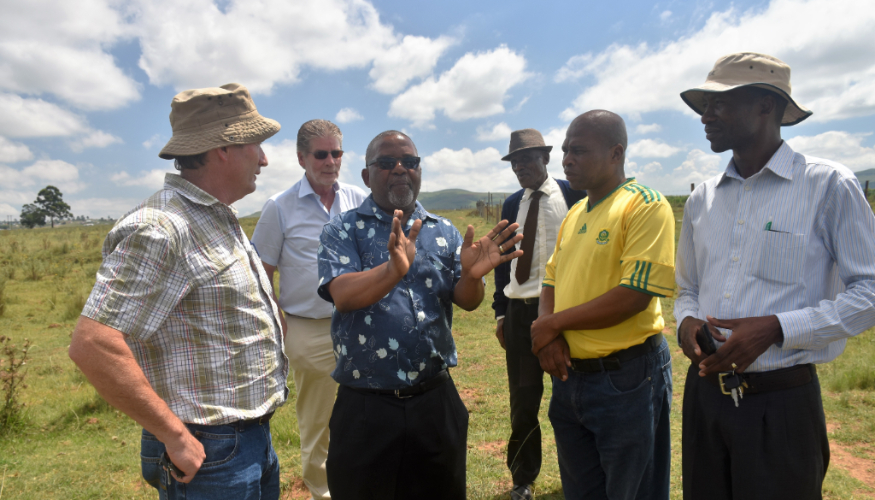
South Africans deal with water issues in a very special way. We can learn a lot from them, says Hans Waals, chief executive of the Blue Deal partnership in South Africa.
“It is not where you start, but how high you aim that matters for success.” These words from Nelson Mandela fit perfectly with the ambitious goals of the Blue Deal: to help 20 million people in 14 different countries to have clean, sufficient and safe water.
Strategic consultant at the Dutch water authority Hollandse Delta Hans Waals is chief executive of the Blue Deal partnership in South Africa.

As such, Waals knows how severe the consequences of drought can be. “Like in Cape Town 6 years ago. The city was at a serious risk of running out of water altogether. To avert this catastrophe the city council and water authority started to warn the people. By continuously informing them of the consequences, they succeeded in bringing down household water consumption by more than halve. They did not go from 100 to 0 overnight. They reduced consumption in stages. But they made it. Day zero never came, but it was a close call.”

“Over the years, we have built a good water network in South Africa,” Waals says. “Our contribution is aimed at improving water quality and water availability. We do this, for example, by training managers and maintenance people of sewage treatment plants.”

In South Africa, there are very large differences between the various ethnic groups, Waals goes on. “These are also reflected in the distribution of water. 60 per cent of the available freshwater goes to agriculture and 95 per cent of that goes to rich white farmers. Because of South Africa’s past, other groups have been put at a disadvantage. They do not have the knowledge to stand up for themselves. So stakeholder empowerment and levelling the playing field are very important.”

That is why the South Africans have found a clever way of involving stakeholders in their water management. And the Netherlands can learn a lot from this, says Waals.
“So water authorities organize a meeting 4 times a year, where all stakeholder groups come together and explain what their interests are. Together, they then decide what needs to be done. In this way, they get to know each other and understand each other’s situation better.”

“I once experienced a session like that about the drought in Kwazulu Natal. There were no acute problems yet, but there was the prospect of them. Instead of quarreling about a solution, both industry and agriculture as well as the people of Kwazulu Natal agreed to reduce their water consumption straightaway, so there would be more water left for the really dry period. All groups agreed, voluntarily. I think that’s amazing.”
Framework for Blue Deal Phase 2 has been published

The Blue Deal Framework Phase 2 has been published. This framework contains the plans and agreements for the period 2023-2030.

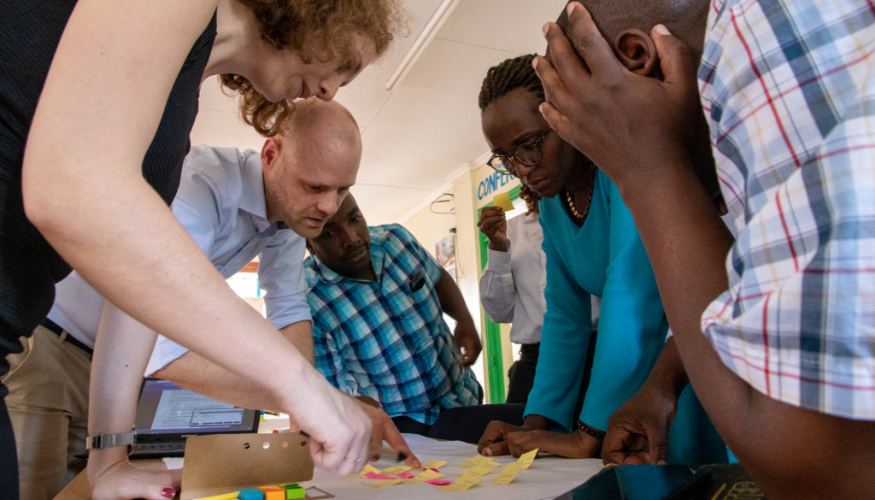
A group of people is looking at sticky notes on a table

At present – only a few years away from 2030 – the world is in a decade in which more decisive action is needed to achieve the Sustainable Development Goals (SDGs). So the Dutch Water Authorities, the Ministry of Foreign Affairs and the Ministry of Infrastructure and Water Management are deploying more resources to grow the Blue Deal in Phase 2 of the programme. The programme’s financial scope will grow from €16 million in Phase 1 (average of €5 million per year) to €80 million in Phase 2 (average €10 million per year). This way, they aim to contribute even more to SDG 6.3-6.6 (clean water and sanitation) and SDG 13 (climate action).

How the Blue Deal works

The Blue Deal programme comprises 17 international partnerships in which water authorities from the Netherlands and other countries work together to achieve the goal of helping 20 million people around the world to gain access to clean, sufficient and safe water by 2030.

Water authorities enter into a 12-year partnership in which we work on long-term solutions for the region. The Blue Deal strengthens capacity building of water authorities in other countries so that they can implement long-term solutions. The focus is on governance and integrated water management. This means that partners work together to promote:

  • adequate knowledge and expertise in the field of water management;
  • strong institutions;
  • collaboration with important stakeholders.

Results Phase 1

The Blue Deal programme is divided into 2 phases: 2019-2022 and 2023-2030. A large part of Phase 1 coincided with the outbreak of the COVID-19 pandemic. The pandemic delayed results, but also provided valuable lessons on hybrid working and the value of strong local teams. The partnerships have worked on strengthening local institutions and capacity building of the local teams. They’ve also worked on topics such as hydrological models, monitoring systems and early warning systems.

Next steps for Phase 2

In the second phase, the programme will further expand the institutional improvements that have been achieved with the partners and continue with their substantive implementation. The aims of Phase 2 are:

  • The water authorities abroad will be at the heart of the programme.
  • The Blue Deal aims to leverage other investment programmes.
  • Learning from each other and other stakeholders will become an important part of the programme, for example through Communities of Practice.
  • We will retain approaches that proved effective during COVID-19: hybrid working, strong local teams and the deployment of Young Experts.

Besides this, climate adaptation and social inclusion will be the crosscutting themes for the programme. Each partnership will make this part of their approach.

> Read the Blue Deal Framework Phase 2

The Netherlands doubles Blue Deal commitment

The Dutch national government and Dutch Water Authorities are doubling their joint annual commitment within the Blue Deal to 10 million euros per year in the period 2023-2030. Minister Liesje Schreinemacher for Foreign Trade and Development Cooperation made this promise on 14 July in New York during the High Level Political Forum on Sustainable Development. The goal of the Blue Deal: to help 20 million people worldwide to gain access to sufficient, clean and safe water.

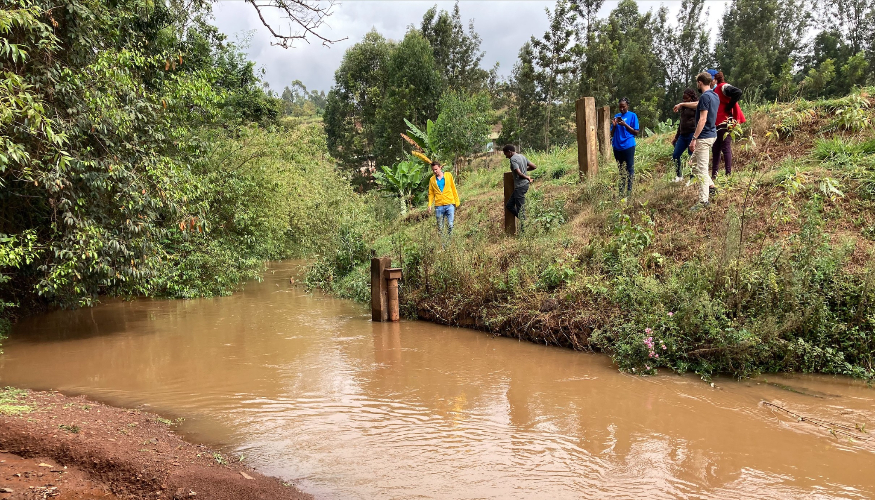
Dutch Water Authorities on a work visit in Kenia

In this way, the Netherlands wants to contribute to achieving the Sustainable Development Goals (SDGs). The minister also called on other countries to work more and faster on clean water and sanitation worldwide. The focus on water during the High Level Political Forum on Sustainable Development is a prelude to the major UN Water Conference in March 2023, hosted by the Netherlands and Tajikistan.

Climate action means water action

During her speech, the minister indicated that there should be a Water Action Agenda. “Science teaches us that water and climate in particular are inextricably linked: 90% of all disasters are water-related, which is why climate action is water action.” Doubling the annual budget for the Blue Deal was the Netherlands’ first commitment to the Water Action Agenda. Schreinemacher called on the other countries to take similar actions.

Blue Deal

The Blue Deal is the international program of the 21 water boards (Dutch Water Authorities), together with the Ministries of Foreign Affairs and Infrastructure and Water Management. The program started in 2018 and the second phase that the minister is now announcing will run from 2023 to 2030. The program consists of 17 long-term partnerships in 15 countries.

Problems are increasing

Luzette Kroon, board member International Affairs at the association of Dutch Water Authorities: “Water managers all over the world are noticing the consequences of climate change. Floods, droughts and a lack of clean water are increasing worldwide. Therefore, there is an increasing demand for knowledge and expertise in the field of water management. And that is exactly what the Dutch Water Authorities have to offer. We would like to share that knowledge and expertise. The program thus contributes to achieving SDGs 6.3 – 6.6.”

Gaining knowledge

In addition to sharing their own knowledge, the Dutch Water Authorities also gain knowledge from the partnerships. New ideas and experiences arise that can also be used in the Netherlands. For example, countries such as Burkina Faso and South Africa have years of experience with drought, something that is relatively new in the Netherlands. In addition, the work of the water authorities in the Blue Deal partnerships also creates opportunities for Dutch and local businesses.

First visit to Mali in 2 years

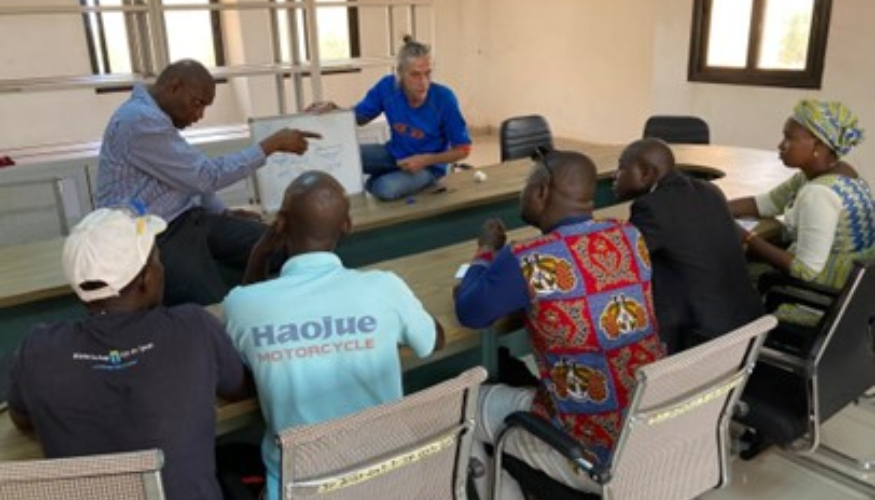
In May the first visit of the Blue Deal Dji Don Mali team in 2 years was realised. The Dutch Embassy Bamako also joined the opening of the visit to local partner Agence National de Gestion des Stations d'Epuration du Mali (ANGESEM).

The team covered key themes including safety at work, maintenance plans and Phase 2 priorities based on the SWOT analysis conducted by Blue Deal. This enables the programme to identify where the Blue Deal will focus to contribute to improving wastewater quantity and quality management.

The mission solidified the partnership commitments of working together and there was a strong team spirit throughout the week.

Successful work visit to Peru

From April 16 until April 30 a team from Dutch Water Authorities visited Peru for the Blue Deal. This was the second work visit since the corona pandemic.

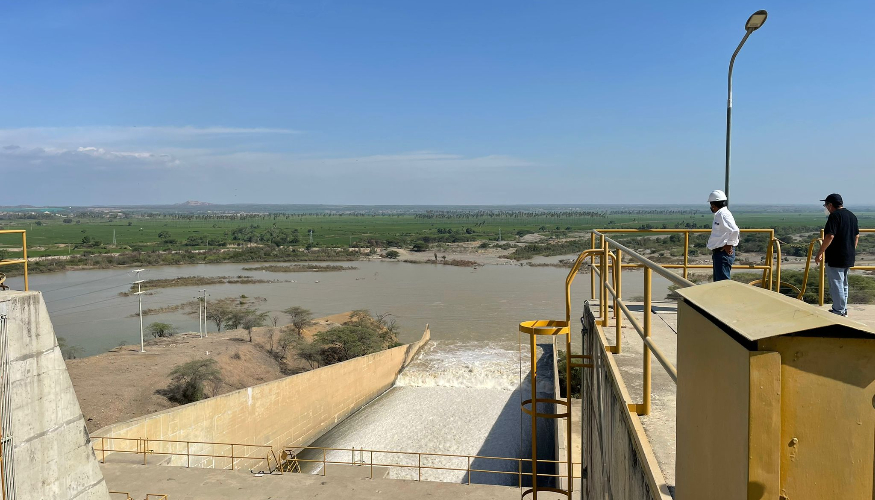
The team spoke with its local partners, the water boards of Piura and Tumbes. Together they analysed the progress of their collaboration. The team also looked into the challenges of water scarcity and the distribution of the available water and where extra support from Dutch experts is needed. Another topic was the planning for the rest of the year and the second phase of the Blue Deal programme, which will last from 2023 until 2030.

Water scarcity and flooding

The work visit therefore consisted of a lot of meetings and discussions, for example with the National Water Authority and with users of the water and stakeholders. Field visits to several sites provided insight into the local situation. In both Piura and Tumbes the problem is pretty much identical: water scarcity during part of the year and danger of flooding during the rainy season. The work visit also showed that the quality of the surface water needs to be improved through waste water treatment plants.

Stronger relationship

The work visit strengthened the bonds between Dutch Water Authorities and the local partners and the perspectives for future collaboration have been broadened. The partnership aims to send in Dutch experts to Peru for several times in the coming years to establish a strong work relationship that helps to improve the water management in Peru. In between these work visits there will also be online meetings to exchange knowledge.

Crocodile River project back on track

In November 2021 the Dutch team was finally able to meet their colleagues from the Blue Deal partnership in South Africa again. They visited the Crocodile River Project. The project is now ready to start again.

In the Blue Deal Crocodile River Project, the Dutch Water Authorities and South African partners work together with the objective to improve the quality of the Crocodile River.

Because of COVID-19 the project collaboration went on only via digital meetings. And few will deny, this was sometimes quite a challenge. Due to this, the project came to a halt. Fortunately, in November 2021 it was possible for the team to meet each other live again, which was very inspiring. Now the project is back on track.

Buhle Shongwe, technician Water Demand & Conservation: “We want to grab each and every opportunity, so we’re excited to be working once again with you.”

Colombian delegation visits the Netherlands for Blue Deal

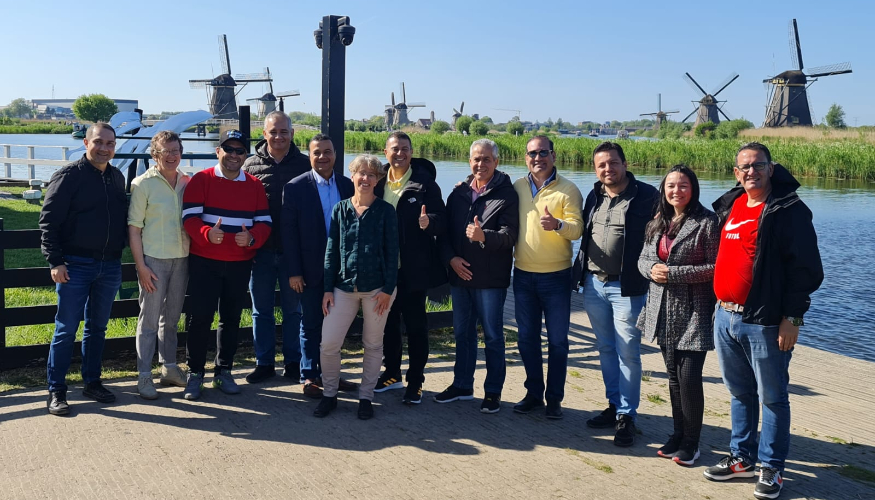
A delegation of Colombian directors from the water sector visited the Netherlands from May 8 until May 15. The visit was part of the Blue Deal program InspirAgua.

Group photo of Colombian directors

Within InspirAgua Dutch water authorities are working together with their Colombian partners. They do this through inspiration and sharing knowledge and experiences with each other, for example on the issue of participative monitoring. This cooperation ensures a further professionalization of water management in both the Netherlands and Colombia. The main goal: better water management and cleaner water for millions of people in Colombia by 2030.

Good cooperation

The visit of Colombian directors from the water sector to the Netherlands underlines the good cooperation within InspirAgua. The delegation was introduced to tasks in water management in the Netherlands. Including water storage, room for the river and the restoration of ecological values. In addition, the directors spoke to representatives of Dutch Water Authorities, various ministries and the Colombian embassy in the Netherlands.

Mutual learning and inspiration

Erik de Ridder, highest board member of the water authority De Dommel and administratively responsible for the InspirAgua programme, is pleased with the visit: “It is important and good to welcome a large delegation of Colombian directors involved in InspirAgua to the Netherlands. In this way they gain even better insight into the work we do within the program. We learn from them and they learn from us. That works best if you can view the assignments together on location. The visit is a confirmation of the constructive and fruitful cooperation between Colombia and the Netherlands and is a good basis for the follow-up.”

Creating joint added value

Luzette Kroon, board member of Dutch Water Authorities and administratively responsible for the Blue Deal, clearly sees the added value of the collaboration within InspirAgua: “We have to adapt spatial planning in the Netherlands to climate change. We can learn a lot from the way Colombia really does that together with its inhabitants.”

First work visit to Colombia since corona crisis

During work visits in September, October and November the Dutch water authorities visited their Blue Deal-partnership in Colombia for the first time in 1,5 year. This provided new energy and a boost to the program. "Digital working is so much different from working together and figuring out where the real problems lie and what it takes to solve them."

InspirAgua is the name of the Blue Deal-program in Colombia. In this partnership Dutch and Colombian water professionals share their knowledge and experience, to inspire each other. InspirAgua focuses on the every day work, to help people and organizations to work together with the right tools.

The necessity of physical meetings

The latest work visit before the corona crisis took place in March 2020. After that, the program continued digitally, but not with the same results as through physical meetings. Ellen Bollen-Weide, the Dutch program manager of InspirAgua: “Technically we could keep working during the corona period. However, we noticed that it was mainly sending information. And that’s a lot different from working together and figuring out where the real problems lie and what it takes to solve them.”

April this year it became clear that it was very difficult to achieve results by working from a distance. That’s why work visits were planned as soon as corona measures permitted them.

Results

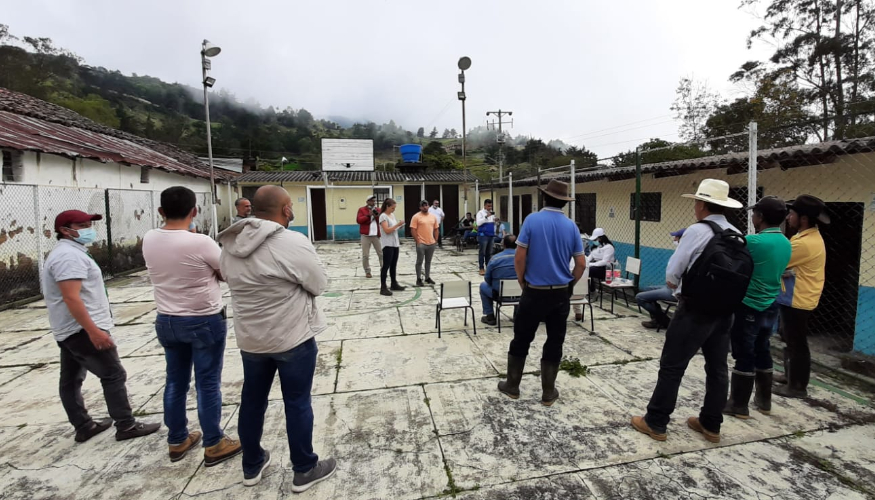
The Dutch water authorities visited their partners in Valle del Cauca, Caldas, Santander and Huila. They talked about the annual plan for 2022 and made the plans concrete. They also discussed the agenda for 2022 with all partners involved. Contacts were reinforced and all partners are still very positive about the cooperation.

During these last visits we’ve had some successes in the projects. In Valle del Cauca a new cooperation agreement was drawn up. In Santander big steps were made on topics such as participative monitoring and stakeholder analysis. In Huila the work plan for 2022 was finalized for support of the operational management and maintenance of smaller sewage treatment plants. And in Caldas we’ve talked about a cooperation agreement to support the construction of a sewage treatment plant for the southern part of Manizales (about 250.000 residents).

Let’s go (again)!

Program manager Bollen-Weide: “This past period we’ve set up technical committees, that were eager to start. That’s something we did achieve by continuing our work digitally: our contacts have been maintained and we were able to make a flying start, now that we can really start working together again.”

First wastewater-to-energy plant in Mali

The Blue Deal partnership in Mali facilitated a pre-feasibility study at a wastewater treatment plant. The goal of the study is to see if an existing wastewater treatment plant could be developed into the first energy-producing wastewater treatment plant in Mali.

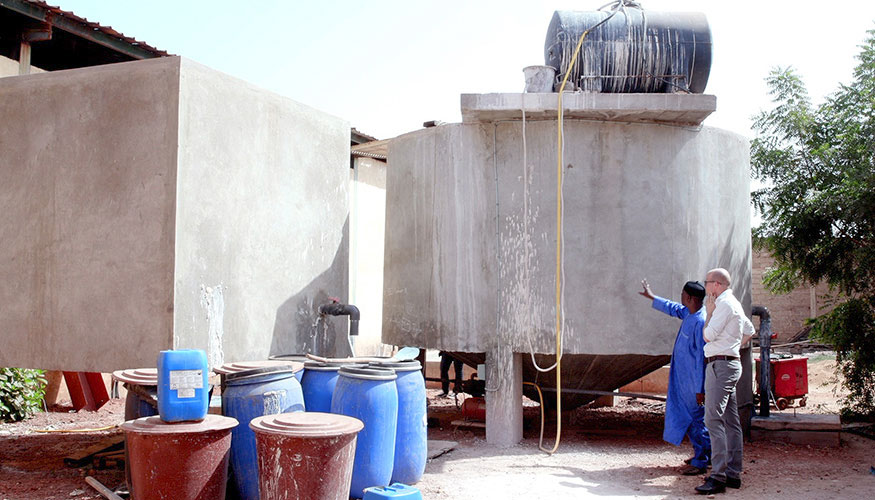
Two men viewing a wastewater treatment plant in Mali
Visit to a wastewater treatment plant in Mali

The energy-producing wastewater treatment plant would be the first project of its kind in Mali. The project is being carried out with support from the Dutch Fund for Climate and Development and SNV.

More on the Blue Deal partnership in Mali

OECD investigates water governance in Peru

The Organisation for Economic Co-operation and Development (OECD) published a report on water governance in Peru. Although Peru is making progress in water management, there are still issues with flooding, drought, pollution and access to clean water.

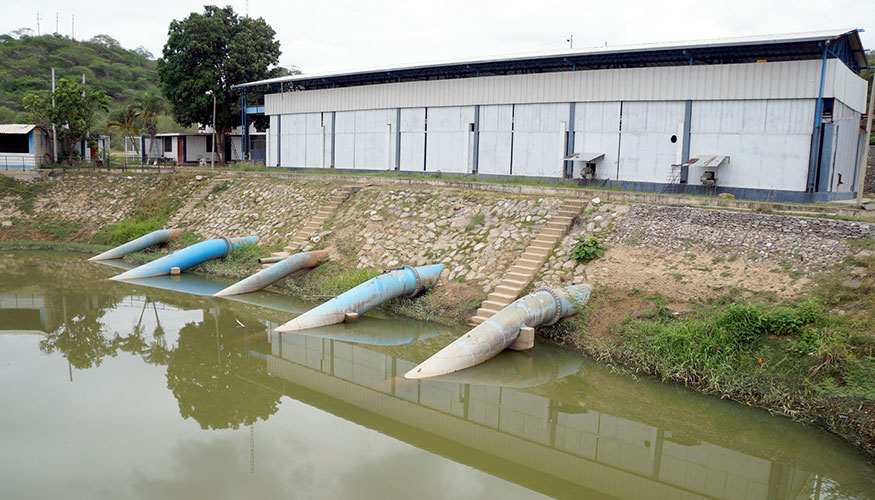
Waste water management installation in Peru
Waste water management installation in Peru.

The OECD report provides an analysis of water governance in the country and gives policy recommendations to strengthen the multisectoral approach to water in Peru. For example, it recommends improving the use of economic instruments to protect and sustainably use water resources, its sources and related ecosystem services. Another recommendation is to strengthen regulatory conditions to improved access to safe drinking water and sanitation in urban and rural areas.

View the OECD report