Conference marks landmark for Blue Deal partnership South Africa

On November 24, the Blue Deal Conference for the South Africa Partnership was held in Johannesburg. David Mahlobo, the South African Deputy Minister of Water and Sanitation, and Dutch and South African employees of the various projects were present. During the conference, the partner agreement for the Blue Deal Phase 2, which runs from 2023 to 2030, was signed.
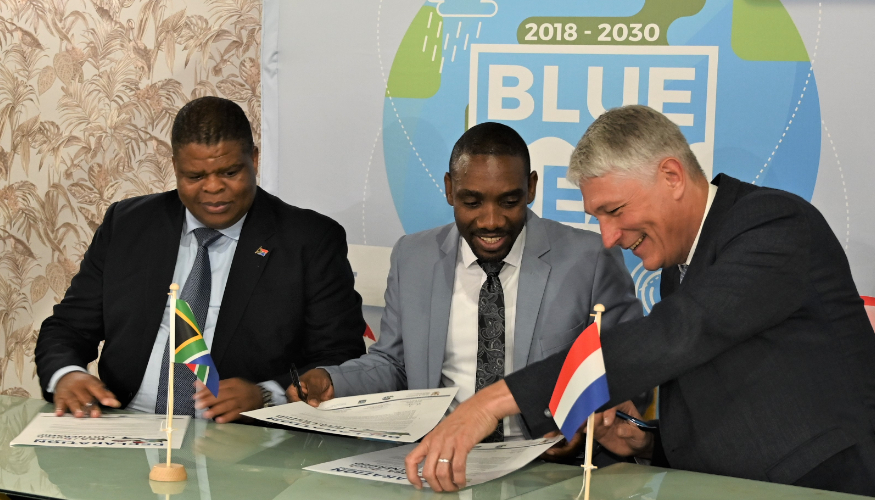
David Mahlobo, Deputy Minister Water and Sanitation, Risimati Mathye, Deputy Director-General Water Services Management and Hein Pieper, Chairman of the Blue Deal South Africa, sign the Partnership Agreement.

Clean and sufficient water for 2.5 million people in South Africa by 2030: that is the goal of the South Africa Blue Deal partnership. South African and Dutch water experts work together to improve water quality in major rivers. The partnership runs from 2018 to 2030.

Take responsibility

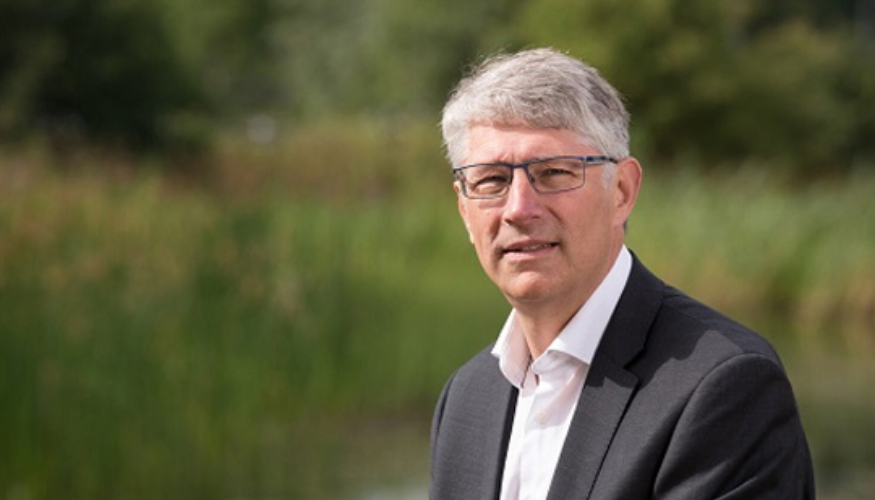
Hein Pieper, chairman of the Blue Deal for South Africa, was there: “We have to go faster, in this second phase. Climate change makes that necessary. And I’m not just talking about institutional changes. Projects succeed because people take responsibility. They act on the basis of underlying values and feel ownership of a project. Here in South Africa, it is about the immense importance of clean water for the basic needs of 2.5 million people.”

Objective: improving the water quality of the major rivers

The 4 projects of Phase 1 (2018-2022) focused on improving the water quality of major rivers such as the Vaal River, the Crocodile River and the Msunduzi River. A large part of this period was during the corona crisis during which only virtual meetings were possible. The Dutch and South African water experts who worked together learned a lot during this period. They kept in touch, organized virtual missions and shared knowledge through webinars. For example, about combating the water hyacinth, innovation in purification, community involvement and river management.

Reflection and looking forward

The Blue Deal conference was an important moment to reflect on the process of recent years, the successes and the challenges. Not everything went smoothly during the corona years. Political changes created different relationships and priorities. It is difficult to deal with this in an exclusively digital environment.

That’s why it’s important to keep meeting each other. That opportunity was there during the conference. More than 140 participants from various cooperation partners attended. Not only to look back, but especially to look forward to Phase 2, while using the experience of previous years. And with an increasing understanding of how we can share it with people facing similar challenges. Not only in South Africa, but also beyond.

Concrete examples

That may all sound a bit abstract. Concrete examples? In Blesbokspruit, the local population uses the removed water hyacinth, a proliferating exotic that impedes the flow of water, as raw material for useful products. In the Vredefort Dome project, the local population is encouraged by the Blue Deal to keep the river free of waste. Blue Deal members also performed remote, virtual inspections of treatment plants in the Crocodile project. And in the Msunduzi project, the Blue Deal shared vital data between various organizations.

Curious? An impression of the projects at the end of Phase 1 of the Blue Deal South Africa can be viewed in the video.

New project added

We will enthusiastically continue with the 4 existing Blue Deal projects. And there will be a new project: Theewaterskloof. There we will work on the waste (water) problem in a township in an urban area that is expanding rapidly.a
A mission to be proud of: re-focus on Msunduzi partnership

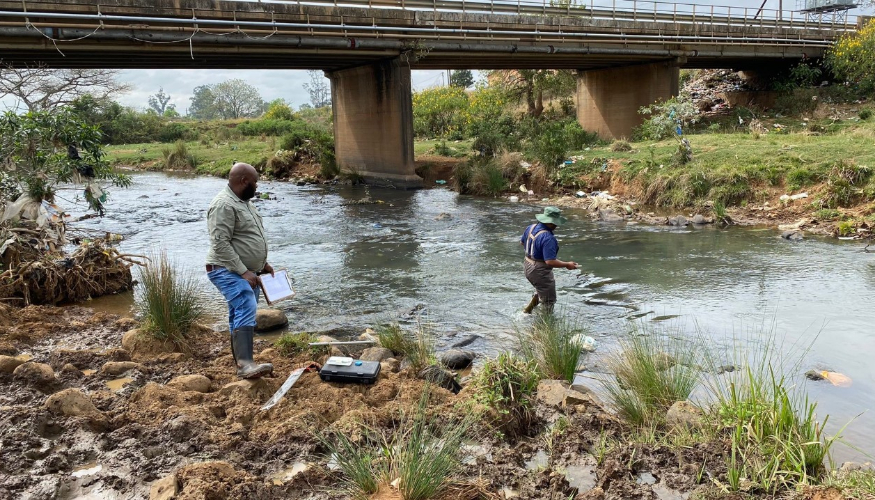
In September 2022 the Blue Deal team had the chance to visit South-Africa again for the Msunduzi River Corridor Improvement programme. The goal for the week was to meet with stakeholders, and to discuss the first phase of the programme and how to proceed together in the second phase. After several fruitful discussions with stakeholders, it resulted in an action plan to investigate how to move forward together.

Ministerial Task Team

There was also time to look at achievements of the first phase of the programme. The delegation went to the Darvill sewer outfall pipes. One of the pipes has been restored as an interim solution. The Blue Deal partnership was used as a platform to elevate the serious situation of the Darvill sewer outfall pipes. This resulted in the establishment of a Ministerial Task Team. There is now a medium-term solution in place.

Water Flag

The delegation also met the local industries to obtain consensus on the pilot of the Water Flag in Phase 2 of the Blue Deal. The idea is to encourage private sector businesses and industries to engage in self-declaration and self-disclosure of key metrics on water use to obtain a ‘Water Flag’. This flag will be placed over their site on a ‘live’ Google Earth Map. The concept was shared and has been positively receive.

Blue Deal South Africa at the WISA conference

From 28 till 30 September 2022 the Biennial Conference of WISA, the Water Institute of Southern Africa, took place in Sandton-Johannesburg, South Africa. At the conference there was a presentation about the Blue Deal.

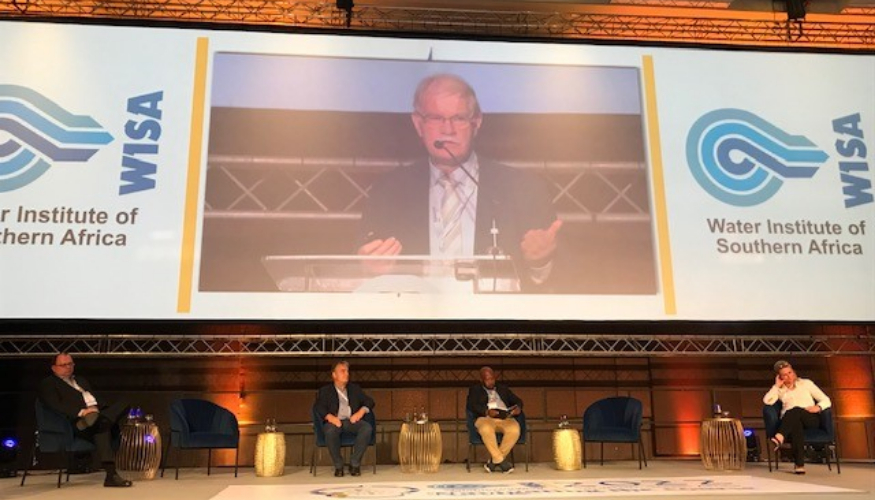
A man is seen on a large screen, while other people are sitting on the stage in front of the screen
Hans Waals, chief executive of Blue Deal South Africa, speaks at the WISA conference.

During the WISA conference delegations from countries all over the southern part of Africa come together to share their challenges and insights. Both Dutch and South African members of the Blue Deal partnership in South Africa visited the conference.

Looking backward and forward

In a 2-hour session the Blue Deal programme was presented: the Dutch-South African partnership, the successes and the lessons learnt of the first phase (2019-2022) and the conclusions drawn at the end of the first phase. One insight came back in all presentations: the challenges in the projects are not so much technical as organisational, e.g. a lot can be gained by more cooperation and institutional alignment.

What happpens after 2030?

Afterwards there was a vivid discussion with the visitors of the workshop. Amongst other issues the question was raised what is going to happen after the end of the Blue Deal Programme in 2030. How to ensure that the results are sustainable? Visitors brought forward the idea that, by that time, South Africa should have built its own Blue Deal programme. With the goal to create partnerships with several other countries to further improve the water management. That would truly be a longlasting outcome of the Blue Deal programme.

A clean river starts with me, today!

The South African Blue Deal partnership's Vredefort Dome project has been quite successful in the past year. A Blue Deal delegation from the Netherlands visited this project in September and found out that most agreements from the previous visit had been fulfilled.

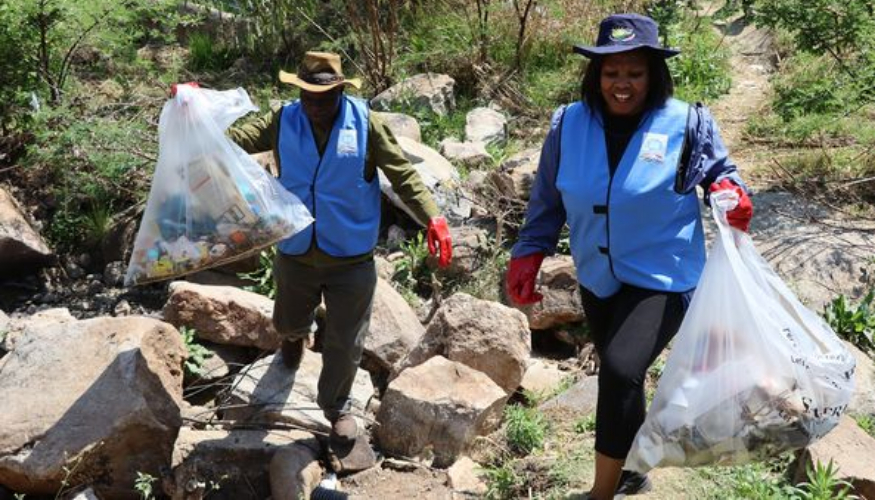
The South African project manager Dr. Konanani Khorommbi and the Executive Mayor of Ngwathe Victoria De Beer-Mthombeni leading a cleaning campaign.

The April 2022 work visit had agreed on improvements to the Waste Water Treatment Work at Parys. Pumps would be replaced and generators repaired, so during periods of load shedding (without power) there would be fewer spills of sewage water.

Mayor of Ngwathe calls for action, action, action

The Mayor of the municipality Ngwathe, Victoria De Beer-Mthombeni, was present during a clean-up campaign organised as part of the World Clean Up Day. More than 20 large rubbish bags of dirt were collected in 2 hours. A community awareness event was also organised in which the mayor gave an impassioned speech that something really needs to be done and that the municipality and community need to do it together. That really helps in making progress. Her approach is: “No more plans, but action, action, action.” The slogan for the campaign is: “A clean river starts with me, TODAY!” Blue Deal plays an important and visible role in this campaign as a brand name and driving force.

Vredefort Dome at the WISA conference

From 28 tot 30 September 2022 the Biennial Conference of WISA, the Water Institute of Southern Africa, took place in Sandton, South Africa. In a 2-hour session the Blue Deal programme was presented, including all the projects in South Africa. Progress on the Vredefort Dome project in phase 1 was also discussed. In addition, attention was paid to the preparation of Phase 2 of this project. An approach was chosen in which technical aspects, stakeholder involvement and monitoring (and communication) are leading. For each subject, 1 main objective will be described in Phase 2 and each objective will have a maximum of 5 key actions. The intention is that all further activities will be clustered under these objectives.

T+S+M = clean river

People often ask for a short description of the approach. The Blue Deal partnership chose to present it in a mathematical equation: Technical + Stakeholder + Monitoring = Clean River. This was presented during the WISA conference. It was discussed after the presentations. People said that they were missing the F of finance in the equation. The Blue Deal does not bring in large investments, but it can support to use the available money differently. For example by extending the technical lifespan by organising good operation and maintenance.

Interview Hein Pieper: “Water is the most important commodity on earth”

Why do we have a Blue Deal and what can we achieve? Hein Pieper elaborates on how the Blue Deal helps 20 million people worldwide to gain access to clean and sufficient water, and to protect them against flooding. Pieper is chairman of the Dutch water authority Rijn en IJssel, president of the European Union of Water Management Associations (EUWMA) and cofounder of the Blue Deal.

“Water is the most important commodity we have on earth,” Pieper says. “Even in a delta like The Netherlands, water can be scarce these days. In other parts of the world, water and water pollution have caused problems for much longer. To be able to tackle these problems we need maintenance, training, monitoring, and so on. But unfortunately, there is no money for that. Dutch Water Authorities wants to change that. That’s why they joined forces with the Ministry of Foreign Affairs and the Ministry of Infrastructure and Water Management to work with other organizations around the world in the Blue Deal programme.”

The goal of the Blue Deal is to help 20 million people worldwide to gain access to clean and sufficient water, and to protect them against flooding. Pieper: “Blue Deal tries to bring this about by entering into partnerships with local organizations in fifteen countries. What is unique, is that these are not one-off but long-term projects. The Dutch share their knowledge of management and governance, which our partners can use to their advantage. But we learn from them as well, about drought for example. Reciprocity and respect for each other are very important.”

To be able to meet the Blue Deal deadline of 2030 the Dutch Water Authorities and the other promoters have decided to increase their joint financial commitment to the programme to 10 million euros per year. International cooperation like the Blue Deal is important, Pieper says. “It provides us with new insights and makes us more appealing to new employees. Colleagues working for the Blue Deal go home enriched. They have learned to approach familiar problems in an entirely different context and that gives them a new perspective.”

Collaboration with eSwatini confirmed during work visit

At the beginning of September, Nettie Aarnink, member of the executive board at the Dutch water authority Vechtstromen, visited eSwatini. The most important part of this work visit was the visit to "the honorable Minister Mabuza" of the Ministry of Natural Resources & Energy. During this visit they made agreements about the role and input of the national government for the next phase of the Blue Deal partnership.

Agreements have been made about the personnel and financial input that the national government will provide in eSwatini. Agreements have also been made to support one of the most important processes for the further decentralization of water management in Eswatini. The visit and speeches of Mabuza and Aarnink received a lot attention on television and in the newspapers.

Gender workshop

Another important part of this work visit was to contribute to the gender workshop for the Joint River Basin Authorities (JRBA) and the main partner organizations of the JRBA. As in the Netherlands, there are fewer women than men active in the water sector in eSwatini. But there is an important difference: much more than in the Netherlands, the work of the water authorities has a direct influence on the lives and futures of girls and women.

Often it is the girls who have to fetch water for the family. A great deal of time is lost when the distance between the water well and the home is increased. For girls, this is at the expense of school time, sometimes girls are no longer able to go to school. In addition, it is often the women who grow the crops for their own family. Good water management is of vital importance to them. Hence the focus on gender. Aarnink contributed to this by sharing her experiences in the Netherlands and in other African countries and by talking to the board members of the JRBA.

UNDP, European Union delegation and WaterAid

Finally, visits were also made to the UNDP, the European Union delegation in eSwatini and to WaterAid. These organizations are already involved and the Blue Deal would like to connect them (even) more to the activities in eSwatini. All in all, a very useful work visit that will have an impact on the cooperation within the Blue Deal partnership.

> Read more about the Blue Deal partnership in eSwatini

Work visit to Colombia in June and July

Last June and July, representatives of Dutch Water Authorities travelled to Colombia. Here they worked in 5 regions on participatory monitoring, wastewater treatment, crisis management and other themes. In workshops with regional partners, input was collected for the plan for Phase 2 of the Blue Deal, from 2023 to 2030.

This work visit was part of the Blue Deal programme InspirAgua. Within this programme plenty of knowledge and expertise in water management is exchanged between Dutch and Colombian water professionals. The work visit was concluded with a presentation by InspirAgua with explanations from directors of the organizations involved during Acodal, the network conference for (international) cooperation in the Colombian water sector.

To get an impression of one of the projects that was visited, watch this video on LinkedIn.

Work visit to the Netherlands

At the beginning of October, InspirAgua will receive Colombian colleagues in the Netherlands during a technical work visit on water governance in Colombia. Using the three-layer model, the development of a governance network in Colombia will be discussed, taking into account its purpose, structure, scope and actors.

During the visit, attention will be paid to drawing up recommendations for national policy in relation to integrated management of water resources ‘PNGIRH’ in Colombia and the new national development plan. Wageningen University & Research is organizing a reflection workshop on work experience in an international context and knowledge development in water management.

Want to stay informed about the activities within InspirAgua? Follow the program on LinkedIn.

3 BluElephants launched in the Palestinian Territories

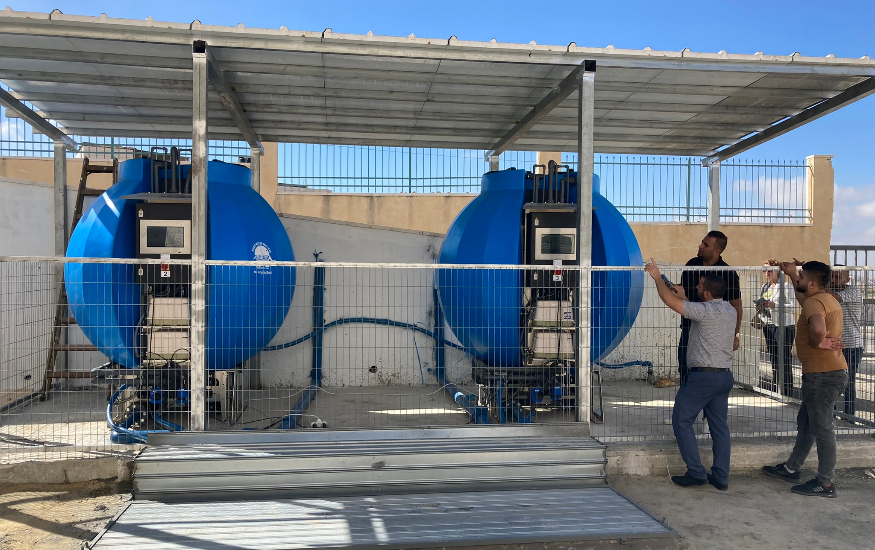
In September, 3 wastewater recycling units, or 'BluElephants', were officially launched in Salfeet and Halhul in the West Bank in the Palestinian Territories and are piloted for 2 years.

People looking at 2 BluElephant units

The pilot is part of the Blue Deal partnership together with the WaterWorx programme. The Blue Deal partnership is working on improving water quality and water management in Palestinian Territories.

The units have arrived at the Palestinian locations where there is an urgent need for wastewater treatment: the President Mahmoud Abbas Governmental Hospital in the city of Halhul (two BluElephants) and one at the Red Cresent clinic, office building and apartments in the city of Salfeet.

Urgent need

In most municipalities of the Palestinian Territories there is no sewage wastewater treatment in place and there is an urgent need for wastewater treatment. Like many countries, the Palestinian Territories suffer from severe water shortages due to growing water demands combined with extreme weather events due to climate change. Rivers are running dry and groundwater levels are unprecedentedly low. On top of that, the political situation remains tense, and transboundary water sharing is part of the conflict. Saving, recovering and reusing water is crucial in order to safeguard water supplies today and in the future. Therefore, the launch of the 3 BluElephant units at 3 Palestinian locations was welcomed with open arms.

Proud

Dr. Fadi Danna of the President Mahmoud Abbas Governmental Hospital in the city of Halhul (2 BluElephants) states: “I am so proud to have the BluElephants at the hospital ground and to show the public the need for treating waste water, to ensure a good environment, public health and more water availability. The BluElephant is truly a blessing since Halhul Municipality does not have any collection or treatment system.”

In the coming years, the Dutch-Palestinian Water Operators’ Partnership will closely test and review the functioning and applicability of the units in Palestinian Territories and elsewhere around the world.

> Read more

Turning water hyacinth into useful products

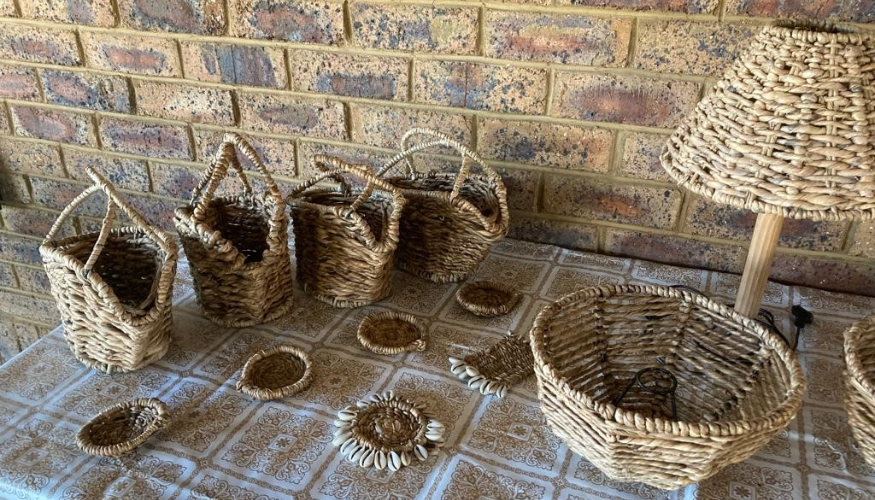
The 19th of July was a day of celebration for 11 women in Blesbokspruit, South Africa. After a training of 6 or 12 weeks they finished their training in entrepreneurship from the Thekga company. The women have been trained to make useful products out of the harvested water hyacinth.

The Blesbokspruit project is part of the Blue Deal partnership in South Africa. The objective of this project is to improve the water quality and thereby restore the ecological status of the wetland. The project aims to improve quality of the water in the Vaal river area, which millions of people depend on.

From threat to opportunity

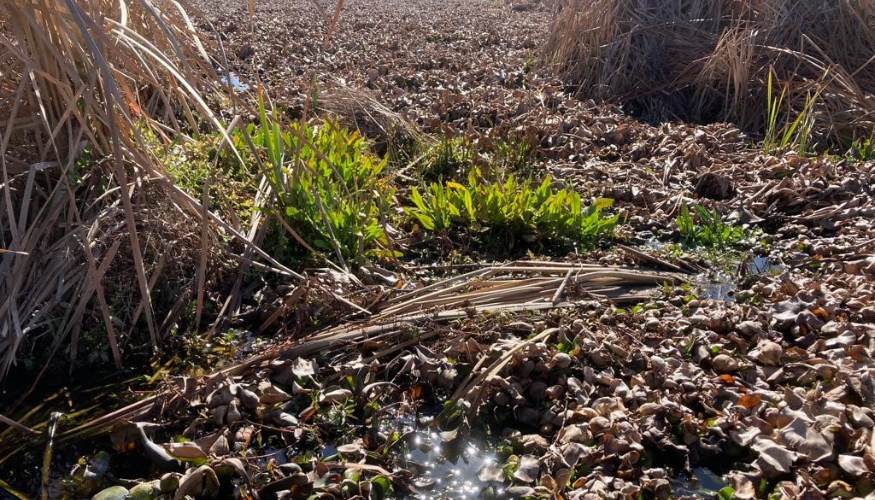
The use of the water hyacinth for the production of articles and home decoration is an interesting example of how a threat can be changed in an opportunity. The water hyacinth is one of the invasive species that blossom as a result of the bad water quality in many locations in South Africa. The water hyacinth gets removed by hand and by machines. There are also plans to use the water hyacinth on a wider scale for biobased products because there is plenty of it. When a water hyacinth plant blooms, the seeds will stay in the ground for 20 years, which means it is a difficult specie to eradicate.

Blesbokspruit work visit

The celebration of the graduates was part of the program of the Blesbokspruit work visit in July 2022. Other important parts of the visit were:

  • the preparation of the signing of the Memorandum of Understanding with all the stakeholders in September 2022;
  • the evaluation of the results and lessons learned of the first phase of this Blue Deal partnership;
  • the preparation for Phase 2 of the Blue Deal programme;
  • the selection of a new Young Expert for a traineeship programme of 2 years;
  • the alignment of the water quality goals, activities and planning.

Water evaluation and planning in Mozambique

Water is scarce in Africa. Yet, the people living in the African Republic of Mozambique use it in abundance and often without paying any taxes. As part of the Blue Deal, Dutch Water Authorities is helping the ARA-Sul water authority in southern Mozambique to identify the effects of people's water consumption and to improve the process of levying charges. ARA-Sul itself has launched a radio and tv campaign to call on residents to register.

Climate change represents a huge challenge for water managers everywhere. The numbers of floods, droughts and a lack of clean water are increasing and there’s a growing need for knowledge and expertise on water management. The goal of the Blue Deal programme is to help 20 million people around to world to gain access to clean, sufficient and safe water. To that end, Dutch Water Authorities forms international alliances with local water authorities elsewhere.

6 years of drought

In all, there are 17 partnerships in 15 countries, of which the Mozambique partnership is the most extensive one. It has resulted in pilot projects that aim to improve flood forecasting, water quality, distribution of available water and operational plans. “A better distribution of the available water is key,” says Martin Bos, Programme Director of the Dutch water authority Wetterskip Fryslân. “The most recent drought in the country lasted for 6 years.”

Shortage of water is a common occurrence, adds Lizete Diaz, Head of Water Resources Services at the ARA-Sul water authority in southern Mozambique. “Take the reservoir behind the Pequenos Libombos dam, for example. It’s supposed to hold a supply of water that lasts the region for 3 years. But in 2020 there was only 20 per cent of that normal supply left. Fortunately, things have improved since then. But we need to manage and monitor our water resources better.”

WEAP-model

The introduction of WEAP (a model for Water Evaluation and Planning) has helped ARA-Sul with this. “Not only does WEAP establish different scenarios for the effects of water usage and climate change,” Bos explains. “It makes clear how ARA-Sul can best deal with them as well.” Diaz adds: “It helps us understand how much water we have. And just as important, how we can best distribute it.”

In Mozambique surface water is mainly used for agricultural and industrial purposes, groundwater for drinking. “WEAP only applies to surface water,” Diaz goes on. “There is another model for groundwater. Currently, we’re running a pilot in Maputo, so that we understand how much groundwater is available for consumption.”

Taxes

As in many countries, water management is costly in Mozambique. “But unfortunately, it’s not easy to levy taxes,” Diaz says. “That’s why we help ARA-Sul to improve the levying process,” Bos adds. “If a farm is using water for irrigation, for example, or an industrial company is polluting one of the rivers, we’ll try to make them foot the bill.”

The partnership is also helping to determine the appropriate rates and develop an administration system for creating and sending invoices. But the problem is: ARA-Sul has nowhere to send them to, since many consumers have failed to register. Diaz: “We’ve started a campaign on radio and television asking people to make themselves known. It has been quite a success. In the first 3 months, there were hundreds of new registrations.”

If residents refuse to register, at some point they will be fined, Diaz says. “But not just yet. I have faith in people. Let’s wait and see how our campaign plays out.”

Text: Pieter Verbeek